Quantum Sensing (NV, SiC, Organics)

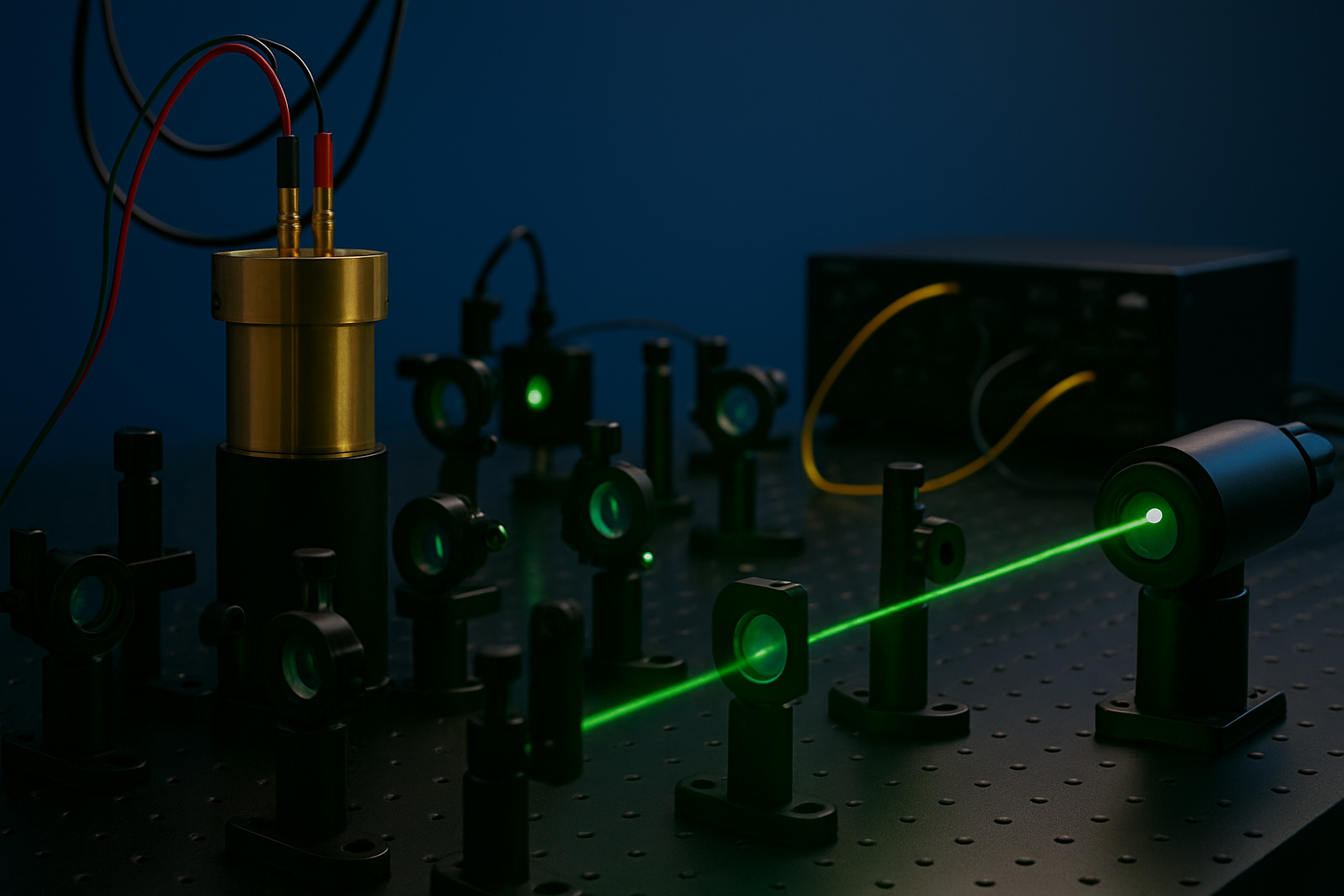
Room-temperature quantum sensors using NV centers, Si vacancies in SiC, and triplet states in doped organic crystals for ultra-sensitive magnetometry, thermometry, and pressure sensing.

Quantum Computing & Simulation

Algorithms on IBM Quantum and a simulation-based NMR QIP, with emphasis on nuclear and chemical Hamiltonians for materials and many-body physics.

Instruments We Build

We design and fabricate RF chains, FPGA-based control, and precision electronics—rapid iteration to unlock new experiments.

Physics Education, Upgraded

We integrate modern tech and data-rich experiments to deepen understanding and engagement across physics courses.

Research Projects

Quantum sensing with NV, SiC and organics

Quantum Sensing (NV, SiC, Doped Organic Crystals)

We develop room-temperature quantum sensors based on NV centers in diamond, silicon-vacancy centers in SiC, and photoexcited triplet states in organic crystals. Our work combines optical spectroscopy, pulsed ODMR, and spin-dynamics control to achieve highly sensitive and robust measurements of magnetic fields, temperature, and pressure. We study defect physics, initialization and readout pathways, spin-relaxation channels, and perform zero-field ODMR where useful for compact instrumentation and on-chip integration.

Applications include nanoscale magnetic resonance, materials characterization, microscale thermometry, and precision metrology. We also explore in situ patterning and engineering of defects (e.g., vacancy creation in SiC) to control density, homogeneity, and coherence times.

Quantum computing and simulation

Quantum Computing & Simulation (IBM Quantum, NMR QIP)

We design and analyze quantum algorithms with a focus on simulation of nuclear and chemical Hamiltonians, error-aware variational methods, and kernel-based learning. We work both on IBM Quantum backends and a simulation-driven NMR quantum information processor, benchmarking performance under realistic noise and gate constraints. Current efforts include compiling chemistry-inspired circuits, exploring biased-noise regimes, and co-designing control with device-level error models.

Quantum error correction

Fault-Tolerant Quantum Error Correction

We study surface and color codes, threshold behavior, and resource requirements for near-term architectures. We prototype decoder strategies tailored to biased noise and time-correlated errors and examine syndrome extraction and lifetime scaling under realistic control errors. The goal is practical fault-tolerance recipes that map onto devices available today.

Custom RF and FPGA-based instruments

Custom Scientific Instrumentation (RF, FPGA, Control Electronics)

We build our own measurement stacks: RF front-ends, low-noise analog chains, switching networks, and FPGA-based timing/control for multi-channel pulse generation and synchronized readout. Fast iteration lets us push new pulse sequences, duty cycles, and phase-cycling schemes into experiments quickly. We also design compact ODMR heads and modular optics for rapid reconfiguration.

Physics education innovation

Physics Education Innovation

We incorporate modern sensors, data acquisition, and computation into undergraduate and graduate teaching labs to deepen conceptual understanding. Projects include portable spectroscopy and magnetometry modules, open-source analysis notebooks, and inquiry-based experiments that bridge fundamental concepts with quantum-era instrumentation.

Grants and initiatives

Grants & Active Initiatives

  • IUAC (New Delhi): Creation of Silicon Vacancies in Silicon Carbide for Quantum Sensing Applications (Awarded Jan 2025).
  • High-density quantum materials & devices: functionalized micro-porous structures and bubble-printed nanodiamond platforms for ODMR imaging and sensing.
  • Noise-aware simulation: chemistry and many-body models on IBM Quantum with resource-constrained, bias-aware compilation.
  • RF/FPGA platform: scalable pulsed ODMR/NMR control with open-source tooling and reusable hardware modules.


Publications

2025

  1. Singh, H.; D’Souza, N.; Garrett, J.; Singh, A.; Blankenship, B.; Druga, E.; Montis, R.; Tan, L.; Ajoy, A. “High sensitivity pressure and temperature quantum sensing in organic crystals.” Nature Communications (Accepted, 2025). (arXiv:2410.10705v1) [DOI] [PDF]
  2. Blankenship, B. W.; Rho, Y.; Jones, Z.; Meier, T.; Li, R.; Druga, E.; Singh, H.; Xia, X.; Ajoy, A.; Grigoropoulos, C. P. “Optically Detected Magnetic Resonance Imaging and Sensing Within Functionalized Additively Manufactured Microporous Structures.” (arXiv:2502.16434) [DOI] [PDF]
  3. Singh, H.; D'Souza, N.; Zhong, K.; Druga, E.; Oshiro, J.; Blankenship, B.; Reimer, J. A.; Breeze, J. D.; Ajoy, A. “Room-temperature quantum sensing with photoexcited triplet electrons in organic crystals.” Physical Review Research, 7, 013192 (2025). [DOI] [PDF]

2024

  1. Blankenship, B.; Li, J.; Jones, Z.; Parashar, M.; Zhao, N.; Singh, H.; Li, R.; Sophia, A.; Sarkar, A.; Yang, R.; Meier, T.; Rho, Y.; Ajoy, A.; Grigoropoulos, C. P. “Spatially Resolved Quantum Sensing with High-Density Bubble-Printed Nanodiamonds.” Nano Letters, 24, 9711–9719 (2024). [DOI] [PDF]

2023

  1. Singh, H.; Anisimov, A. N.; Baranov, P. G.; Suter, D. “Zero-Field ODMR and Relaxation of Si-Vacancy Centers in 6H-SiC.” Materials Research Express, 10, 11 (2023). [DOI] [PDF]
  2. Blankenship, B. W.; Jones, Z.; Zhao, N.; Singh, H.; Sarkar, A.; Li, R.; Suh, E.; Chen, A.; Grigoropoulos, C. P.; Ajoy, A. “Complex 3-Dimensional Microscale Structures for Quantum Sensing Applications.” Nano Letters, 23, 9272–9279 (2023). [DOI] [PDF]
  3. Kaur, H.; Riya; Singh, A.; Singh, H.; Lal, U. R.; Chaitanya, M. V. N. L. “Molecular recognition of carbonate ion using a novel turn-on fluorescent probe.” Spectrochimica Acta Part A: Molecular and Biomolecular Spectroscopy, 123270 (2023). [DOI] [PDF]
  4. Singh, H.; Anisimov, A. N.; Baranov, P. G.; Suter, D. “Identification of different silicon vacancy centers in 6H-SiC.” (arXiv:2212.10256, 2023). [DOI] [PDF]
  5. Singh, H.; Hollberg, M. A.; Ghezellou, M.; Ul-Hassan, J.; Kaiser, F.; Suter, D. “Characterization of single shallow silicon-vacancy centers in 4H-SiC.” Physical Review B, 107, 134117 (2023). [DOI] [PDF]

2022

  1. Singh, H.; Hollberg, A. M.; Anisimov, A. N.; Baranov, P. G.; Suter, D. “Multi-photon multi-quantum transitions in the spin-3/2 silicon-vacancy centers of SiC.” Physical Review Research, 4, 023022 (2022). [DOI] [PDF]
  2. Breev, I. D.; Shang, Z.; Poshakinskiy, A. V.; Singh, H.; et al. “Inverted fine structure of a 6H-SiC qubit enabling robust spin-photon interface.” npj Quantum Information, 8, 23 (2022). [DOI] [PDF]

2021

  1. Soltamov, V. A.; Yavkin, B. V.; Anisimov, A. N.; Singh, H.; Bundakova, A. P.; Mamin, G. V.; Orlinskii, S. B.; Mokhov, E. N.; Suter, D.; Baranov, P. G. “Relaxation processes and high-field coherent spin manipulation in color center ensembles in 6H-SiC.” Physical Review B, 103, 195201 (2021). [DOI] [PDF]
  2. Singh, H.; Anisimov, A. N.; Baranov, P. G.; Suter, D. “Optical spin initialization of spin-3/2 silicon vacancy centers in 6H-SiC at room temperature.” Physical Review B, 103, 104103 (2021). [DOI] [PDF]

2020

  1. Singh, H.; Arvind; Dorai, K. “Using a Lindbladian approach to model decoherence in two coupled nuclear spins via correlated phase-damping and amplitude damping noise channels.” Pramana – Journal of Physics, 94, 160 (2020). [DOI] [PDF]
  2. Singh, H.; Anisimov, A. N.; Nagalyuk, S. S.; Mokhov, E. N.; Baranov, P. G.; Suter, D. “Experimental characterization of spin 3/2 silicon-vacancy centers in 6H-SiC.” Physical Review B, 101, 134110 (2020). [DOI] [PDF]

2018

  1. Singh, A.; Singh, H.; Arvind; Dorai, K. “Experimental classification of tripartite entanglement without prior information on an NMR quantum information processor.” Physical Review A, 98, 032301 (2018). [DOI] [PDF]
  2. Devra, A.; Prabhu, P.; Singh, H.; Arvind; Dorai, K. “Efficient experimental design of high-fidelity three-qubit quantum gates via genetic programming.” Quantum Information Processing, 17, 67 (2018). [DOI] [PDF]
  3. Singh, H.; Arvind; Dorai, K. “Evolution of tripartite entangled states in a decohering environment and their experimental protection using dynamical decoupling.” Physical Review A, 97, 022302 (2018). [DOI] [PDF]

2017

  1. Singh, H.; Arvind; Dorai, K. “Experimentally freezing quantum discord in a dissipative environment using dynamical decoupling.” EPL, 118, 50001 (2017). [DOI] [PDF]
  2. Sharma, R.; Gogna, N.; Singh, H.; Dorai, K. “Fast profiling of metabolite mixtures using chemometric analysis of a speeded-up 2D heteronuclear correlation NMR experiment.” RSC Advances, 7, 29860 (2017). [DOI] [PDF]
  3. Singh, H.; Arvind; Dorai, K. “Experimental protection of arbitrary states in a two-qubit subspace by nested Uhrig dynamical decoupling.” Physical Review A, 95, 052337 (2017). [DOI] [PDF]

2016

  1. Singh, H.; Arvind; Dorai, K. “Constructing valid density matrices on an NMR quantum information processor via maximum likelihood estimation.” Physics Letters A, 380, 3051–3056 (2016). [DOI] [PDF]

2014

  1. Singh, H.; Arvind; Dorai, K. “Experimental protection against evolution of states in a subspace via a super-Zeno scheme on an NMR quantum information processor.” Physical Review A, 90, 052329 (2014). [DOI] [PDF]

Our Team

Principal Investigator

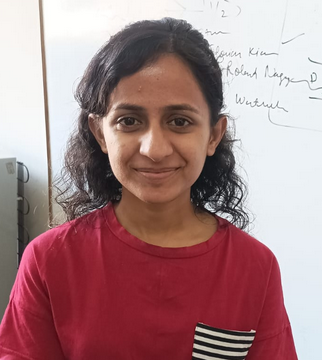
Photo of Dr. Harpreet Singh

Dr. Harpreet Singh

Assistant Professor of Physics

Leads the Quantum Lab at GNDU.

harpreet.phy@gndu.ac.in

Ph.D. Scholars

Photo of Mr. Sumit Choudhary

Sumit Choudhary

Ph.D. Candidate

Quantum sensing and computation.

sumitphy.rsh@gndu.ac.in

Photo of Rajdeep Singh

Rajdeep Singh

Ph.D. Candidate

Focus: quantum sensing.

rajbeepphy.rsh@gndu.ac.in

Undergraduate

Photo of Abdul Baqi

Abdul Baqi

MSc (FYIP) Student

Interests: quantum physics and physics education.

abdulphy.std@gndu.ac.in

Alumni

Photo of Akansha

Akansha

Graduate, 2025

Collaborators

  • Prof. Kavita Dorai, IISER Mohali
  • Prof. Arvind, IISER Mohali
  • Dr. Harjit Kaur, Department of Physics, GNDU, Amritsar
  • Dr. Hardeep Kaur, Department of Chemistry, Khalsa College, Amritsar
  • Dr. Tarunpreet Kaur, Khalsa College of Engineering, Amritsar

Internal

Restricted area. Enter the password to view lab instrument manuals.

Get in Touch

  • Dr. Harpreet Singh
  • Department of Physics
  • Guru Nanak Dev University
  • Grand Trunk Road, Off NH 1
  • Amritsar, Punjab, 143005
  • India

  • Office: Physics Building, Room 310
  • Lab Phone: +91-9815886371
  • Email: harpreet.phy@gndu.ac.in

Prospective Students

We are always looking for motivated and talented students to join our team. Apply via GNDU Physics Department admissions and email your CV + interests.